
By Dr. Michelle Pyo, PowerMyLearning
Math can happen anywhere. Family Math is the everyday opportunity for children and families to talk about and make sense of math together, whether they’re at the store, cooking dinner, or playing a game. At its heart, Family Math helps children experience mathematics not just as something they do at school, but as something relevant, joyful, and part of everyday life.
But for schools working to strengthen Family Math, an important question remains: How do we make these experiences part of a school community and not just a one-time event or activity?
PowerMyLearning has been exploring this question through the California Family Math Initiative (CFMI), alongside the Center for Family Math, Raising a Reader, and the Partnership for Los Angeles Schools. Through our work with elementary school communities, several lessons have become clear.
1. Start with what schools and families are already doing
Family Math doesn’t have to be one more thing for schools or families to do. Start by weaving math into existing events, experiences, and routines.
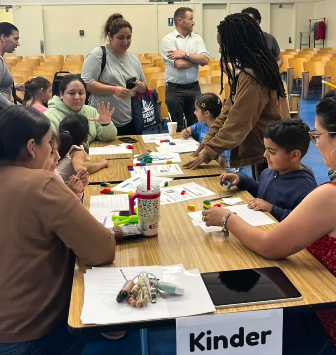
Schools already bring families together for back-to-school nights, literacy events, celebrations, workshops, and other community gatherings. These moments provide natural opportunities to incorporate Family Math in ways that feel connected to the school. A Family Math experience might be as simple as a game families play together, a station where children explain their thinking, or prompts that help caregivers notice and talk about the mathematics within everyday routines.
The same is true at home. Families do not need to recreate a classroom lesson. Instead, schools can help caregivers recognize the math already present in daily life and give them simple ways to build on it.
Practical tip: Before creating a new Family Math event, look at your school calendar. Where are families already showing up? Start there.
2. Identify a champion inside the school
Strong implementation needs more than a good program or set of resources. It needs someone inside the school who can help the work take root.
A school-based champion might be a teacher, instructional coach, family engagement staff member, or administrator. What matters most is that they understand their school community, are excited about Family Math, and can connect the work to what teachers and families are already experiencing.
These champions help answer the small but important implementation questions: When should an activity happen? How should families hear about it? What will make participation easier? What are teachers noticing?
Those details often determine whether a program remains something happening at a school or becomes something that feels like it belongs to the school.
Practical tip: Identify a Family Math champion early and create regular opportunities for that person to share what they are hearing from teachers and families.
3. Use student voice to build trust, joy, and connection
Family engagement in mathematics can carry an extra layer of complexity. Adults bring their own experiences with math into the conversation, and some may feel anxious or unsure about how to support their child.
Successful Family Math experiences should reduce that pressure, not add to it.
At PowerMyLearning, we are exploring this through MathVoice, a K–3 learning experience designed to elevate student mathematical thinking and strengthen the connection between classroom learning and families.
Students complete an engaging math game with a caregiver or peer and then record a brief video sharing how they solved the problem and what they were thinking along the way. This gives teachers a rich window into how students reason, not just whether they arrived at the correct answer.
MathVoice can also extend that learning to home. Families are invited to listen, wonder, encourage, and ask questions about their child’s thinking. They do not need to know the strategy being taught in class or teach the “right” way to solve a problem.
Questions as simple as “How did you figure that out?”, “Why do you think that worked?”, or “Can you show me another way?” communicate something powerful to a child:
Your thinking matters.
Student voice can be a powerful bridge between school and home. Rather than asking families to replicate classroom instruction, experiences like MathVoice give caregivers a window into how their child thinks about mathematics and give children an authentic audience for sharing their ideas.
Practical tip: Give families questions to ask rather than lessons to teach. Simple prompts make it easier for every caregiver to participate.
4. Make the experience feel connected, not like a collection of programs
One of the most exciting aspects of CFMI is that multiple organizations bring different expertise to the same school communities.
Raising a Reader brings deep experience building family learning routines through shared reading and helps families see how books can spark both literacy and math conversations at home. PowerMyLearning’s MathVoice connects Family Math to classroom learning, mathematical discourse, and student voice. The Partnership for Los Angeles Schools has longstanding relationships with school leaders, educators, students, and families.
The real opportunity is to connect these experiences so they build on and strengthen one another.
When partners coordinate family events, professional learning, and other behind-the-scenes supports, families and educators experience a coherent approach to supporting children’s learning.
Practical tip: If multiple organizations support your school, start with the experience you want families and educators to have, then work backward together.
From a program to a culture of Family Math
The biggest lesson from this work is that Family Math cannot live only in a toolkit, an event, or a technology platform.
It grows when teachers invite students to share their thinking, caregivers know they do not have to be math experts to participate, school leaders make space for Family Math within existing priorities, and community partners work together rather than asking schools and families to connect the dots themselves.
The goal is not simply more Family Math activities.
The goal is a school culture in which children regularly hear, at school and at home, that their ideas are worth listening to, mathematics is all around them, and they are capable mathematicians.
For those of us doing this work, there’s an opportunity to look beyond one-off activities and help Family Math become part of the relationships, routines, and learning already surrounding a child.


