
By Rebecca Chrystal, Raising a Reader
At Raising a Reader, our evidence-based model has long focused on building home-based reading routines to drive literacy. However, research shows that math skills at kindergarten entry are the strongest predictor of both math and literacy achievement by 8th grade. Recognizing this, we forged a unique partnership with the National Center for Family Math, PowerMyLearning, and the Erikson Institute to participate in the California Family Math Initiative (CFMI). Our goal is to amplify the joy and power of math by integrating it into the family routines we have already spent decades cultivating.
Empowering Caregivers as the Primary Guide
A core pillar of our mission is reinforcing the truth that parents and caregivers are a child’s first and most important teachers. Many adults may feel anxious or lack confidence in their own math abilities, but you don’t need to be a math expert to support a young learner. The Adventures in Math Learning program is designed to build caregiver confidence by showing that “math talk” is simply an extension of the love, words, and time they already share. By showing enthusiasm and getting involved in everyday moments, caregivers help their children see math as exciting, helpful, and full of possibilities.
Leveraging the “Book Bag” Habit for Math Success
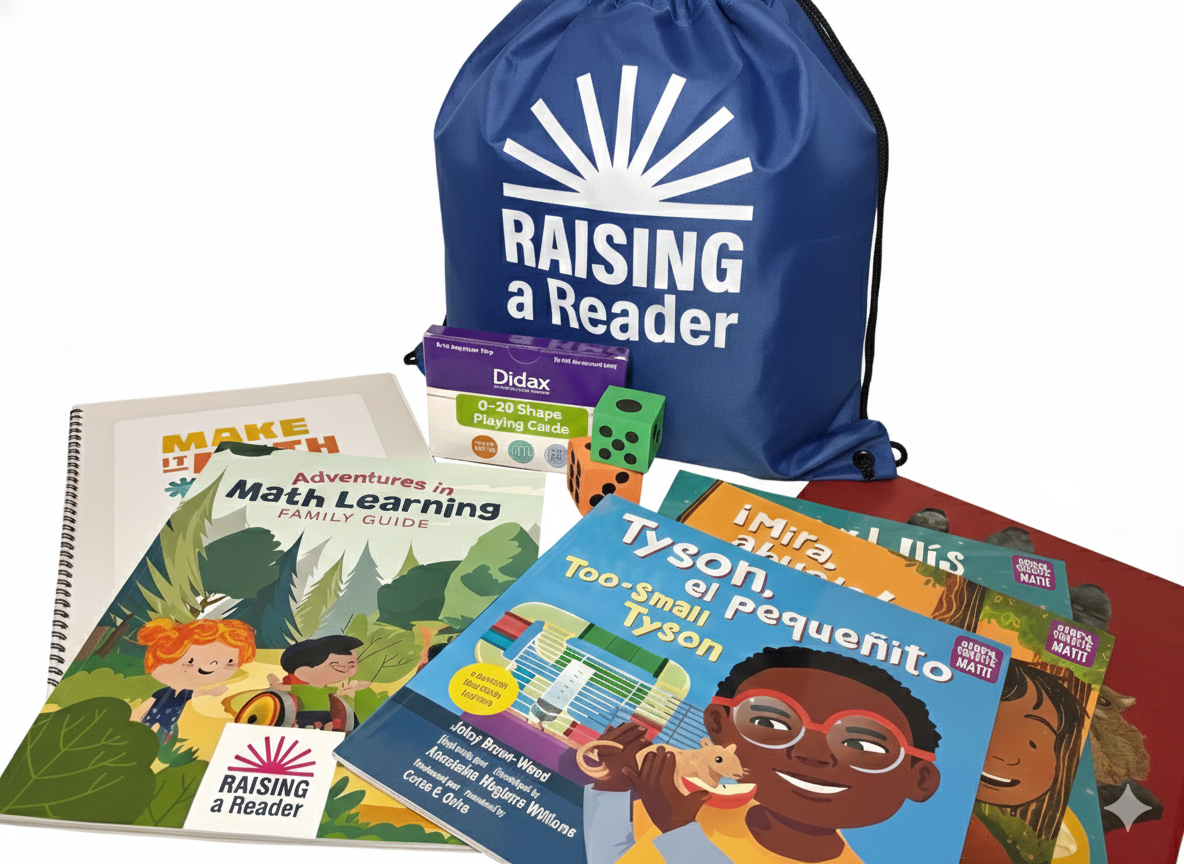
Raising a Reader’s unique contribution to this initiative is the development of a Family Math book bag, called Adventures in Math Learning. The strategy here is “habit stacking”: using a successful, familiar delivery system—the Raising a Reader Book Bag—to introduce “math talk” and shared numeracy activities.
- Adventures in Math Learning is designed to be culturally and linguistically responsive, ensuring all families feel respected and seen. Each kit includes:
- A Bilingual Family Guide: Provides accessible strategies and tips for parents to lead their child’s “math adventure”.
- Curated Bilingual Storybooks: A set of four children’s books that naturally weave math concepts into narratives, transforming storytime into a meaningful way to explore counting, comparing, and shapes.
- Hands-on Manipulatives: High-quality games, subitizing cards, and dice that make abstract concepts tangible and add a fun, engaging element to repetitive practice.
Practical “Math Talk” Strategies
The guide encourages parents to shift their mindset from “getting the right answer” to embracing productive struggle—the moment a child wrestles with a challenge and discovers they are capable of more than they thought. The following “Language Shifts” help adults support their math explorers:
| Goal | Instead of…. | Try Saying…. |
| Celebrate Effort | “You got it right!” | “I love how you kept trying different ways to solve that!” |
| Encourage Strategy | “What’s the answer?” | “What do you notice? How else could we try to figure it out?” |
| Model Curiosity | “I don’t know the answer.” | “Let’s figure it out together. We’re a team of explorers!” |
Integrating Math into Daily Routines
One of the most effective ways to fold math into existing models is to highlight the math that already exists in a family’s day-to-day life. We encourage families to look for math treasures in everyday moments:
Sorting Safari: Use laundry or grocery shopping to teach categorization—grouping items by color, size, or type before counting them.
Counting Quest: Practice “one-to-one counting” (touching each item as you say the number) during routines like climbing stairs.
Spatial Adventures: Use positional words—under, over, next to, behind—while cleaning up or playing to help children build a strong mental map of their world.
Scalable Success and the Road Ahead
In August 2025, we “beta” tested this kit with families across six states. Results were promising: 92% of families reported that their child was excited about the book bag, and nearly 93% found the learning guides easy to use and understand. Most importantly, families reported feeling more confident talking about math and incorporating it into their children’s lives.
Building on this momentum, the Adventures in Math Learning program will be piloted in Spring 2026 and Fall 2026 with families in Los Angeles. We are confident that by merging literacy and numeracy, we are giving children the cognitive tools to grow into confident readers, scientists, and thinkers. We look forward to scaling this program to support family math learning nationwide, ensuring every child has the foundation they need for a bright academic future.


