
By Iliana Gallego, Communication Specialist at the Parent Institute for Quality Education (PIQE)
For many families, math is a difficult subject to support at home. Countless adults might not see math as part of their daily life and practices, and it soon becomes a distant memory of what they learned in school rather than an active skill. Years later, when children come home with questions, frustration, or anxiety about math, many parents find themselves facing the subject with hesitation of their own. The response is familiar. We send our children back to the teacher, pay for tutoring, or attempt to relearn methods we have not used in years, hoping to bridge the gap between what we remember and what our children need.
“Math anxiety is real, not just for students, but for parents too. Common Core math often looks very different from how many parents learned math themselves, leaving families unsure how to help,” said Justine Williams, Director of Curriculum at the Parent Institute for Quality Education (PIQE).
At the Parent Institute for Quality Education, families are at the center of our work. We equip parents and caregivers with the knowledge, confidence, and skills to partner with schools and communities so their children can thrive. Our programs position families as active participants in learning by offering practical, affirming tools grounded in real-life experiences.
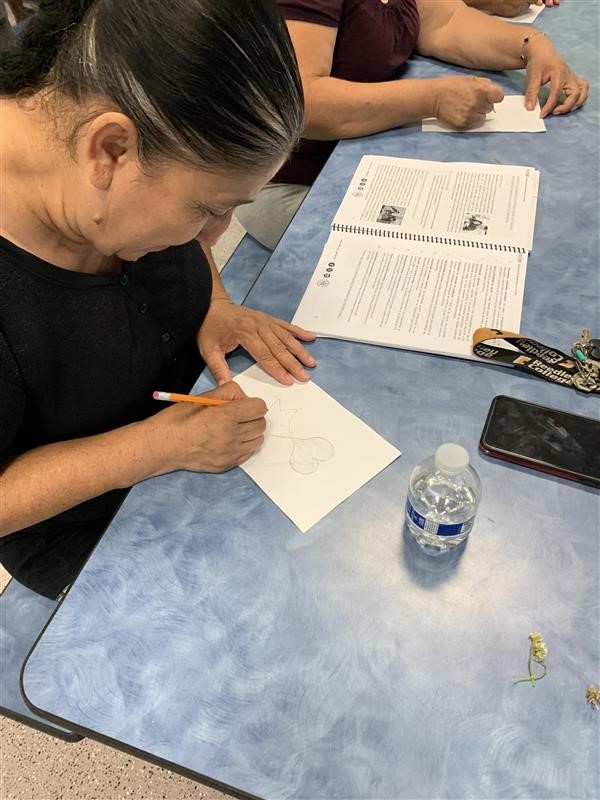
Through partnerships, conversations with school districts, and direct feedback from parents, we heard a consistent concern: many families felt unsure about how to support their children in math and anxious about unfamiliar instructional approaches. Math had become a source of stress rather than connection at home. In response, PIQE developed the Family Math Together Program to reduce math anxiety, rebuild confidence, and help families engage in math learning in meaningful, everyday ways.
“Our goal wasn’t to teach parents math content, but to equip them with strategies, confidence, and tools to make math approachable, fun, and part of everyday life,” said Williams.
The program was designed using PIQE’s established family engagement best practices and developed with the support of Holly Kreider, Director of the National Association for Family, School, and Community Engagement’s (NAFSCE) Center for Family Math. This partnership provided access to national expertise, research-based strategies, and resources that emphasize a simple but powerful message: everyone is a math person.
The design focused on three key principles:
- Empowerment over instruction: Helping families ask good questions, advocate for their children, and create positive math experiences.
- Practicality: Activities that use everyday materials and fit naturally into family routines.
- Connection: Encouraging shared learning moments between parents and children.
To translate these design principles into effective practice, PIQE prioritized intentional implementation and continuous learning during the program’s initial rollout. “To ensure success, we trained a facilitator who was not only passionate about math but deeply empathetic to families’ experiences,” said Elizabeth Cabrera, PIQE’s Vice President of Program & Impact. “Training included hands-on modeling of activities and approaches designed to make math engaging, accessible, and supportive for families.”
The program was piloted in Modesto, with weekly check-ins conducted to gather real-time feedback from the facilitator. A formal pilot reflection meeting was also held with PIQE’s Deputy Director, and both qualitative and quantitative data were collected from participating families. These iterative steps allowed the program to be refined before scaling statewide.
The pilot revealed several clear themes about how families experience math learning at home. Beyond skill development, the findings highlight the emotional and relational dimensions of math, showing how confidence, enjoyment, and connection influence a child’s learning experience.
Key insights from the pilot included:
- Families crave support: Parents want to help but often don’t know where to start.
- Fun changes everything: Games and everyday activities reduce anxiety and make math enjoyable.
- Connection matters: Math became a bridge for family communication and bonding.
Retrospective surveys confirmed that families left feeling more confident, better equipped, and more connected to their children’s learning.
Parent perspectives illustrate these outcomes:
Karen Corona, a mother of a sixth grader and an eighth grader at Keiller Leadership Academy, shared that the program “challenged my mind from the start, broadened my perspective, and changed the way I think.” She added that it helped her communicate more easily with her children about math, understand its real-life applications, and better support them by focusing on mastering each concept before moving on.
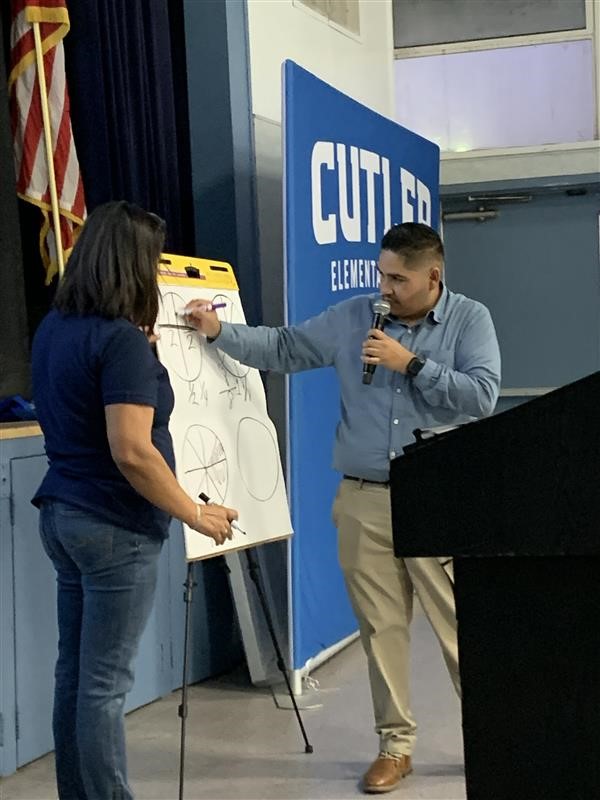
Brandy Taylor, a mother at the same school, highlighted the value of peer learning. “Sharing ideas with other parents was incredibly valuable. We talked about ways to incorporate math into daily life and show our kids that it’s everywhere—not just a one-hour block at school. I really appreciated being able to exchange ideas and have these conversations with other parents.”
Taylor’s perspective is shared by Victoria Gonzalez, a mother at La Mirada Elementary with a first grader and a third grader, who also emphasized the importance of peer participation while noting opportunities for growth. “I would like to see greater engagement from participants. Some people feel hesitant to speak up, which limits how much the group can benefit. There is so much knowledge within the group, and encouraging more active participation would really strengthen the program.”
Top Takeaways for Practitioners
- Start with empowerment, not instruction: Families don’t need to relearn math—they need strategies to support and advocate for their children.
- Keep activities simple and accessible: Use materials families already have at home.
- Address math anxiety head-on: Explain what it is and how to manage it.
- Share resources openly: Families want to know what’s available from schools and districts.
- Build in feedback loops: Regular check-ins with facilitators and families help refine the program in real time.
- Create intentional space for peer-to-peer learning: Families benefit from structured opportunities to learn alongside one another. Sharing experiences, ideas, and strategies with other parents helped normalize math anxiety, surfaced collective knowledge, and built confidence in ways families rarely experience in traditional school settings.
Taylor suggested making the program more interactive by starting with an in person session where families receive kits or handouts with math games to use throughout the lessons. She proposed a shared set of six math games, with all families trying the same game each week to encourage connection and feedback. This approach would allow PIQE to engage children indirectly through their parents, rather than focusing only on adults.
Building on lessons learned during the Modesto pilot, PIQE intentionally incorporated family feedback and implementation insights into the replication phase launched in Fall 2025. As a result, Family Math Together has expanded to 17 sites, bringing this approach to math engagement to families across multiple communities.
Family Math Together is more than a program; it’s a movement to make math joyful, approachable, and a source of connection for families.


