Author: Maggie Caspe, Zully Rodriguez, DéJon Banks, Sara Morrison
The fight for equitable education stands as a cornerstone of our collective journey towards a more just society. At the center of this struggle are parent leaders who advocate for the rights of their own and their community’s children’s educational needs, collaborate with educators and school administrators, engage in school governance, and mobilize and organize other parents to champion educational equity and excellence. Since its inception, the Family Math movement led by the Center for Family Math has placed parent leaders at its core through its Family Math Parent Advisory Committee (PAC). The Family Math PAC is a group of 9 parent leaders representing leadership groups across the country. Because math is such a significant benchmark, the Family Math PAC advocates for children and families of all backgrounds to have access to culturally responsive math opportunities in order to eliminate opportunity gaps in early math.
On February 21st, two members of the Family Math Parent Advisory Council (PAC) – DéJon Banks, Sr. from Parent Voices, Oakland, and Sara Morrison, Choice for All – along with Zully Rodriguez, from Abriendo Puertas and a member of NAFSCE’s Board of Directors and Parent Family Leaders Council, presented to 40 parent leaders participating in Day 1 of Maryland Family Network’s daylong Parent Leadership Institute. Maryland Family Network (MFN) was formed in 2009 to administer Maryland’s network of Family Support Centers. MFN was formed to join together two organizations to more efficiently advocate for and administer Early Childhood programs and services – Maryland Committee for Child and Friends of the Family. The latter was administering Maryland’s network of Family Support Centers since 1986 while the former had been fighting for quality child care in the state since 1945. MFN parent leaders represented Early Head Start and Family Support Center programs throughout the state of Maryland.
Over the course of the day, DéJon, Zully, and Sara shared three main messages to the group: that math is everywhere, that it is dynamic, joyous, and fun, and that we are all leaders. Below are 5 activities that the parent leaders created to communicate their message. The hope is that you can try these activities in your own communities to share the power of parent math leadership.
Activity 1 – What’s Your Number?
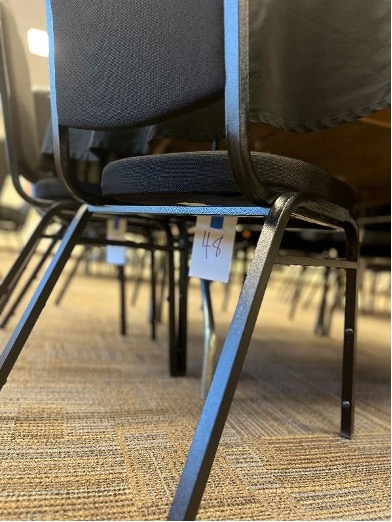
To start the day off, participants were asked to look under their seats. There they found an index card with a number from 1-60 written upon it. Participants were asked to share with the table their memories of that number; from what meaning that number might hold for them, or what comes to mind when they hear that number. The activity was a fun and profound way for participants to get-to-know one another and begin to think mathematically. One mother shared that the number 60 represented the age of her parents when they immigrated to the United States. Participants matched numbers and played games of “higher” and “lower” to choose who would share out loud with the group next.
Activity 2 – A Math Picture Tells A Thousand Words.
To get the group thinking about how math is everywhere in their lives, Dejon, Zully, and Sara asked participants to take out their phones and share a picture that represented family math. One mother shared a picture of cupcakes in the shape of the number “2” – the age that her child had turned for his recent birthday. Another shared a picture of her children playing in the snow measuring the height of their snowman! Each of the pictures sparked conversation about how math is all around us; sometimes we just need a little reminding to see it.
Activity 3- Telling Our Math Stories.
In 2022, the Family Math PAC published the Make It Math: Family Parent Leadership Toolkit. The toolkit provides examples of why family math is important, stories from the community, games and activities to try at home, points for talking with teachers about the importance of family math and advocacy ideas. Dejon, Zully, and Sara each shared their own family math stories, from how they use math in their everyday lives in cooking, sports, and navigating the world with a disability, and asked parent leader participants to tell their own stories too. One mother shared how she talks about math with her child at Target as they’ve learned which stickers indicate a price discount, allowing a child to purchase more. Another mother shared how she and her child count stairs and steps on the way to school. Whatever the activity, everyone agreed it’s fun to Make it Math!
Activity 4 – Playing Games.
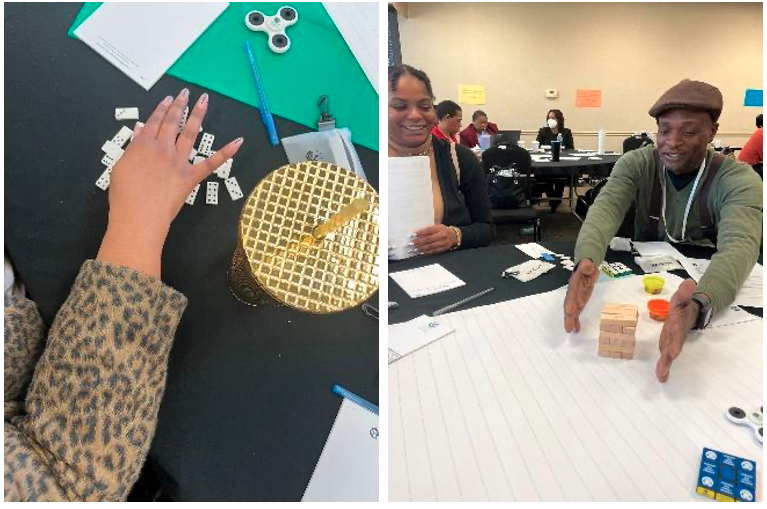
Math is more than just numbers – it’s patterns, shapes, measurement, spatial concepts, and problem solving. To help explore some of these concepts parents played games at their tables. They put together puzzles, built with blocks, played dominoes, cards, and jenga. Playing games also brought out the joy of math. Parents even explored different online apps and games they could use with their children. Some of the favorites were Bedtime Math, the PBS Socal Family Math Toolkit, Math Talk’s Measure Everything, and Young Mathematicians.
Activity 5 – We Are All Leaders.
Math anxiety is like that pesky little bug buzzing around your head when you’re trying to enjoy a picnic in the park. Everyone in the room took a moment to acknowledge that sometimes math can make us nervous because of the way it’s been positioned in our society as a high-stakes gatekeeper. An important way to help our children overcome math anxiety is to focus on persevering in solving problems and adopting a “we can figure it out” mindset in everyday situations. To help us all see ourselves as leaders in the family math space, and in overcoming this anxiety, Zully led the group in an activity developed by Abriendo Puertas in which the group named leaders they admire (for instance Barack Obama, Jesus Christ, and Dr. Martin Luther King, Jr.) and the characteristics they exude (for example, strength, kindness, openness). She then asked each of us to identify those characteristics within us, because at the core, we as parents, are all leaders.
Lessons Learned
The day was a success not only because of the enthusiasm of the participants but because of the care and conditions the MFN team put into organizing the event. Translators were available to all Spanish-speaking participants throughout the day and children took part in a variety of activities while parents were in sessions. At a follow-up Zoom session a week after the event, parent leaders had an opportunity to experience the event not just as a “one off” but rather an ongoing part of their lives. Parents reflected on the experience and what they learned.
One parent leader shared, “I went home to my center and shared all of the apps and information. They were interested in the apps and they are in need of it. They are struggling to teach their children and when I told my experience they liked it and asked for more information. Next week I’m going to give a presentation to all of the parents in my Center so they can learn what I learned.”
Another parent added, “I feel more prepared emotionally and I am seeing math with new eyes. I can teach my son more math now. I want to be a leader for my son and I think I can do this for him.”
Finally, one parent added, “I wanted to say thank you for last weeks’ opportunity. I truly learned a lot and felt a sense of safety with everyone present which allowed me to share as much as I did. I can’t wait to share everything I learned at my next parent council meeting…I am utilizing my resources as a leader and advocating for my children and children in my community of all backgrounds to make a difference.”
Our day in pictures